The world in which live today is influenced by the imagination of those who have come before us and by those who are living now. More often than not, the world in which we live is a product of the imagination of the powerful and affluent within society. How can we create an alternative prophetic imagination that will help us create a world that brings justice to all, including the most vulnerable?
Imperial imagination perpetuates a nightmare for those whom it exploits to maintain and expand its power. Prophetic imagination embraces the freedom to dream of liberation from this nightmare. Unfortunately, we are currently living within systems perpetuated by imperial imagination.
As the Christian theologian Walter Brueggeman reminds us, prophetic imagination is needed to help break us free from imperial systems, but it involves much more than simply pointing out what is wrong with the way things are. Prophetic imagination engages in criticizing the current unjust systems while also energizing persons to imagine new and more just systems and to take the action necessary to bring into being a just and beloved community (See The Prophetic Imagination by Walter Brueggeman).
In the Synoptic Gospels, Jesus is portrayed as having to resist the temptations of being recognized as powerful before Jesus began a public ministry of good news and liberation with the poor, the vulnerable, and the oppressed. The power that is expressed, recognized, and celebrated by the wealthy, elite, and imperially connected is the antithesis of the way of love, justice, and liberation.
Jesus is portrayed as building upon the prophetic tradition of the Hebrew Bible, which is a clarion call for persons to strive for justice for the vulnerable and liberation of the oppressed rather than clinging to power and its trappings of ease and prestige.
We see similar warning about power and the powerful on other religious traditions as well. The Buddha reminds us all that enlightenment and the compassion that flows from enlightenment are not possible if we are attached to power and seeking recognition and approval from the powerful. We can never actualize ourselves authentically if we are seeking our validation as persons from the powerful.
The Buddhist monk Thich Nhat Hanh makes the case that within our society, power is really about cravings related to our desire for things like comfort, possessions, property, sex, status, and wealth. We use our power to control others so that we can pursue our cravings. These cravings are the source of both personal and societal suffering, and they are used my imperial imagination to gain even more power and control over our lives (See The Art of Power by Thich Nhat Hanh).
Thus we see the insight from the wisdom of many traditions that the path to our best selves is not paved with power and money but with love and justice.
One of the most important decisions we make in life is whether or not we will resist the lure and temptation of embracing imperial power and accept the call to embrace the vulnerable and liberate the oppressed. It is the difference between a life of subservience to the powers that bring privilege and prestige and a life committed to love of the least and the lost and to the transformation of unjust and oppressive systems that keep them from flourishing. When the imperial powers bring us to a high place and show us all the power and glory they are willing to give us in exchange for our obedience, our answer must be a resounding and life-giving no!
Part of the prophetic power of Martin Luther King Jr. was in his power to imagine what a more just human community looks like and to energize persons in the difficult and often times sacrificial work to bring the beloved community into existence.
The champion for social Justice, bell hooks, expresses this power of an alternative and prophetic imagination, when she writes: “There must exist a paradigm, a practical model for social change that includes an understanding of ways to transform consciousness that are linked to efforts to transform structures” (See Killing Rage: Ending Racism by bell hooks).
The social activist, Dorothy Day, expressed this power of prophetic imagination when she proclaimed: “We need to overthrow this rotten, decadent, putrid industrial capitalist system” (Dorothy Day in The Catholic Worker). Day recognized that in order to change our unjust systems, we have to resist accepting these systems as an unchangeable given. We must reject the unjust systems and bring forth new systems through an alternative imagination.
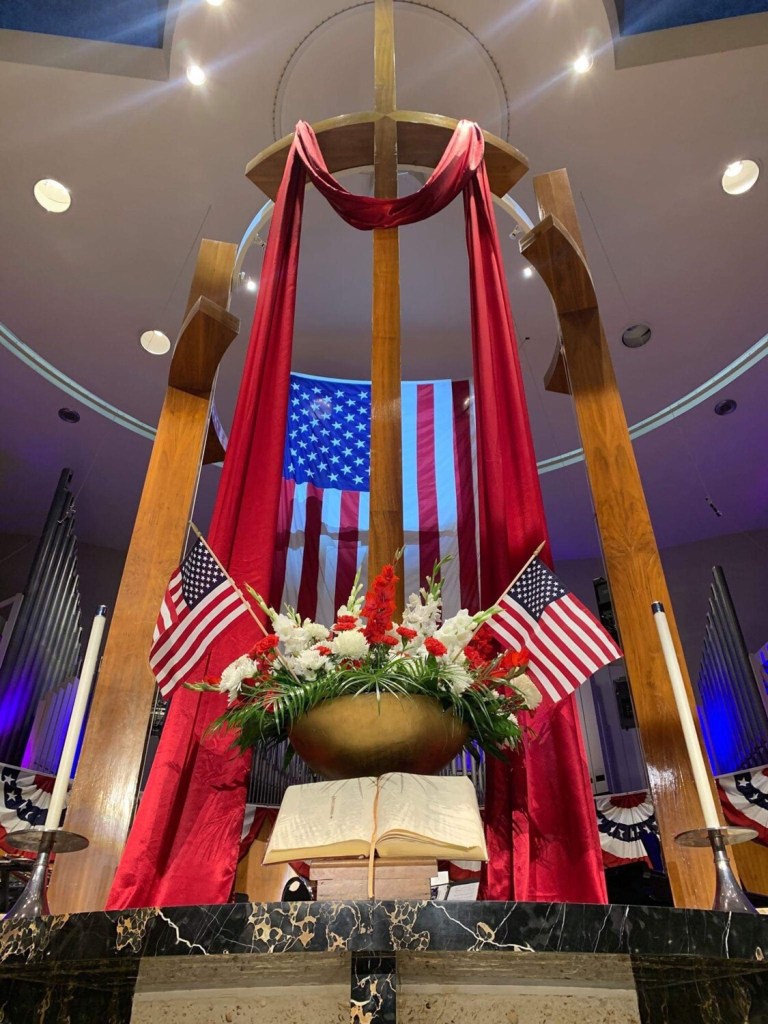
There is perhaps no other time during the year than the Fourth of July that we as a society get more mixed up about what is an imperial imagination and what is a prophetic imagination. There is perhaps no other time that our idolatry in relation to imperial power is more on perverse display than on the Fourth of July.
The Fourth of July is not a Christian holiday or a religious holiday, but it would be difficult to know that if you visited the vast majority of Christian churches in the United States this Fourth of July Weekend Sunday morning. So many churches and so many religious communities are marching so much in lockstep with imperial power brought forth by imperial imagination that the American Empire has literally become an object of worship.
It is important to emphasize that the liturgical color for today for Christian churches is green, not red, white, and blue. The Pledge of Allegiance is not a Christian creed to be recited in church. The American flag is a not a Christian or religious vestment. The National Anthem is not a Christian hymn.
It is difficult to cultivate an alternative prophetic imagination for a more just and beloved community when we are literally worshiping the symbols of imperial power brought forth by the unjust systems of imperial imagination. Walter Brueggeman reminds us that this is pathetic imagination, not prophetic imagination.
What our communities and our society as a whole need most from our religious communities is an alternative prophetic imagination that shows us that we do not simply have to accept our filthy and rotten systems as they are and that energizes us all to work together towards something new, something more loving, and something more just. May it be so, may we make it so together.
 One World House - Mark Davies