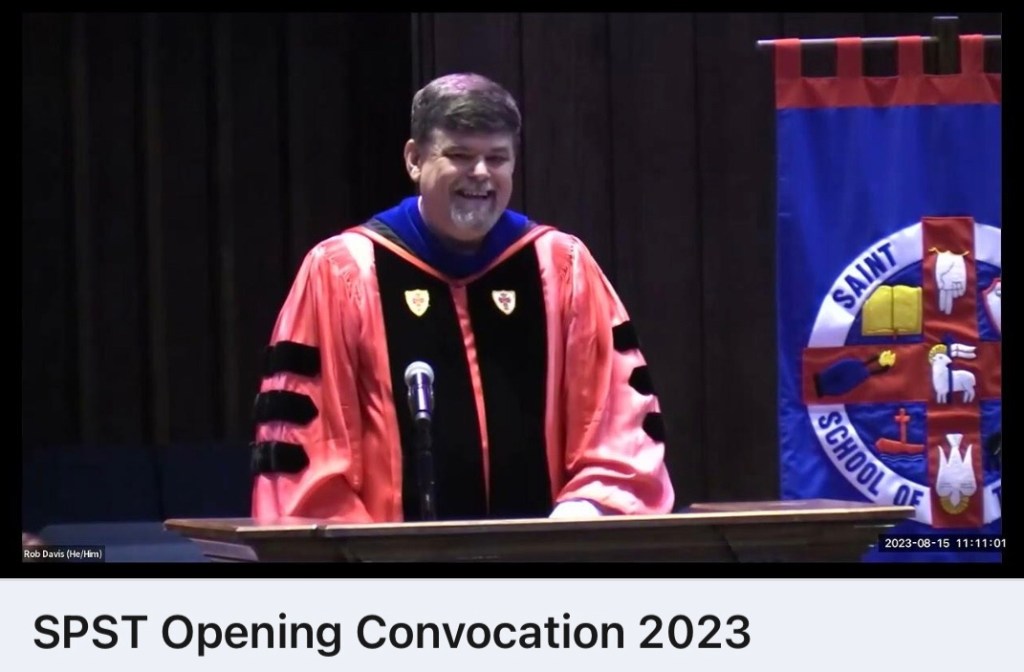
It is a privilege for me to be speaking with you today as part of this opening convocation and as we celebrate the installation of Rev. Dr Sharon Betsworth as Vice President of Academic Affairs and Academic Dean of Saint Paul School of Theology.
In my many years as a colleague and friend of Sharon in our work together at Oklahoma City University and now through her work at Saint Paul School of Theology, I have witnessed first hand Sharon’s expertise as a New Testament Scholar and scholar of religion in general, as a dedicated professor and mentor of students, and as a skilled and highly effective administrator. Sharon’s integrity has a been a witness for all who know her and through her words and actions she continues to live out the heart of one of her favorite biblical passages Micah 6:8 by her work to do justice, love kindness, and walk humbly with God. Even in her scholarly work, her passion for justice and kindness and her concern for the vulnerable in our communities shine brightly as she has made sure to remind us all of the importance of children in the Bible and our responsibility to celebrate and care for children as essential participants within our faith communities.
It is with all of this integrity, compassion for the vulnerable, dedication to students of ministry, and care for the well-being of her colleagues in ministry and theological education that Sharon Betsworth was called last year to begin her service as Vice President of Academic Affairs and Academic Dean of Saint Paul School of Theology, and we need all of the talent, ability, and care that Dr. Betsworth brings for such a time as this in our world and for such a time as this in theological education.
There really are no “ordinary” times within the history of humanity. Every period of human history brings with it complexity and extraordinary challenges and experiences of both tragedy and triumph with an unsettling and unsatisfactory mixture of progress and failure.
And though our time is not unique for not being “ordinary,” I think we can find agreement that our times are not ordinary in a rather extraordinary way, and what Martin Luther King Jr. often referred to as “the fierce urgency of now” has perhaps never been more fiercely urgent than it is right now. We desperately need theological education to address this fierce urgency of now with much more urgency than we have mustered up until now.
The fierce urgency of our context for both our human community and the community of all creation is becoming more and more undeniable. We are experiencing war and violence leading to refugee crises throughout the world; we are experiencing a worldwide surge in autocracy and racist nationalism that threatens freedom and democratic participation throughout the world, and we are causing unprecedented ecological degradation while at the same time billions of persons are experiencing the human deprivations of displacement, poverty, homelessness, hunger, and disease.
Speaking to you today from Oklahoma, I am reminded that our inability to address the fierce urgency of the past often makes the challenges we face today even more difficult to address. Oklahoma was created as part of process of forced removal and genocide of indigenous peoples built on violence, broken promises, and land grabs – injustices from which we have not fully repented and for which reparations have not been fully made. The first official political action by the Oklahoma legislature was to pass and implement a law making Oklahoma a Jim
Crow state. Years of racism, patriarchy, and prejudice have led Oklahoma to become one of the worst places in the United States to live if you are a person who is black, indigenous, a person of color, or a woman. And now Oklahoma is proving itself to be viciously unjust to our trans siblings. And the children, we cannot forget the children whose health, safety, and education we have neglected and whose futures we are diminishing.
We have clearly paid a price in the present for not addressing the fierce urgency of doing justice in the past.
If we look more closely at the ecological degradation we are experiencing, we see that In the last 50 years we have lost nearly 70% of all wildlife on our planet, and the current extinction rate of species is hundreds of times greater than the normal background extinction rate. If we continue at this pace, we may lose half of all currently existing species over the next century. We have entered into what can only be called the sixth great extinction event on earth, and unlike the five other great extinction events in earth’s history, this extinction event is the only one caused by one species.
To make matters even more fiercely urgent, we have created a climate crisis that is quickly hurling us towards an unlivable climate for human civilization and for much of life on earth.
This summer we are being reminded of where our greed and attempts to conquer and control nature are taking us as we have witnessed a new level of extreme events connected to our climate crisis. Just in the last two months we have experienced the hottest June on record, the hottest week on record at the beginning of July, the hottest day on earth ever recorded in the first week of July, and now we know that July was the hottest month ever recorded since we began keeping global temperature records in 1880. 2023 is on pace to become the hottest year since record keeping began.
We see record wildfires in Canada causing almost unbreathable air over vast swaths of North America, record breaking heat waves all over the planet, 101 degree waters off the coast of Florida wreaking havoc on marine ecosystems, and record breaking floods and extreme droughts around the world. And this past week we witnessed the horrific fires on the island of Maui that were exacerbated by factors related to our climate crisis. To borrow some words from our Christian tradition, the whole creation is groaning in travail.
If we needed another reminder of our human capacity to destroy each other and even destroy most of life on earth, a movie came out this summer that reminded us all of just that. The movie Oppenheimer explores the events leading to the development, testing, and use of atomic weapons from the perspective of the scientist who led the work to create the atom bomb. Perhaps Oppenheimer was in a sense speaking for all us when after the detonation of the atom bomb at the Trinity test site in New Mexico he quoted the words from the Bhagavad Gita, “Now I am become Death, the destroyer of worlds.” Our capacity and willingness to destroy each other and the rest of life on earth hold our world in bondage.
It is important for us to lament and to mourn all that that has been lost because of human greed and our inability to address the fierce urgencies of the past and the fierce urgency of now. As the theologian Walter Brueggeman reminds us, unless we fully experience and express lament for our loss, we will likely not see and feel the need for the prophetic imagination required to bring the transformation that is needed to bring healing, wholeness, and justice within our communities.
Although lamenting and mourning are necessary, we must avoid the temptation of despair and hopelessness which can often lead to apathy and inaction. We cannot cling to false hope as way to address the fierce urgency of now, but we need to find realistic hope upon which to ground prophetic imagination that will both criticize the injustice of current systems and energize us to live more fully into the reality of beloved community.
It is in the fiercely urgent context, it is in this time where realistic hope is so important for prophetic imagination and for the transformation of unjust and unsustainable systems within our world, that we are all called to do the important life-giving and life transforming work of theological education – a theological education that embodies the doing of justice, the practicing loving kindness and mercy, and walking humbly with God as we work together for healing in our world.
It is in this fiercely urgent context that we are called to find ways to do theological education that will cultivate and implement a realistic hope that will do no harm to the world, that will do the good work of healing the world, and that will keep us in love with God and each other as we express prophetic social holiness for the transformation of the world.
The work of theological education in the fierce urgency of now is salvific work. It is life saving and world healing work for the community of all creation. The work of theological education must address the fierce urgency of now, or it will contribute to the reality that there is such a thing as too late if we do not act for justice, mercy, and healing in the world so that nothing that is good and just and loving will be lost.
Today I am profoundly thankful that our sister Sharon Betsworth has accepted the call to lead this community in this life giving and life transforming work of theological education as together we live out the realistic hope that beloved community is possible if we come together to address the fierce urgency of now with all the creativity, compassion, and grace that our loving God has first shown us. Amen
 One World House - Mark Davies