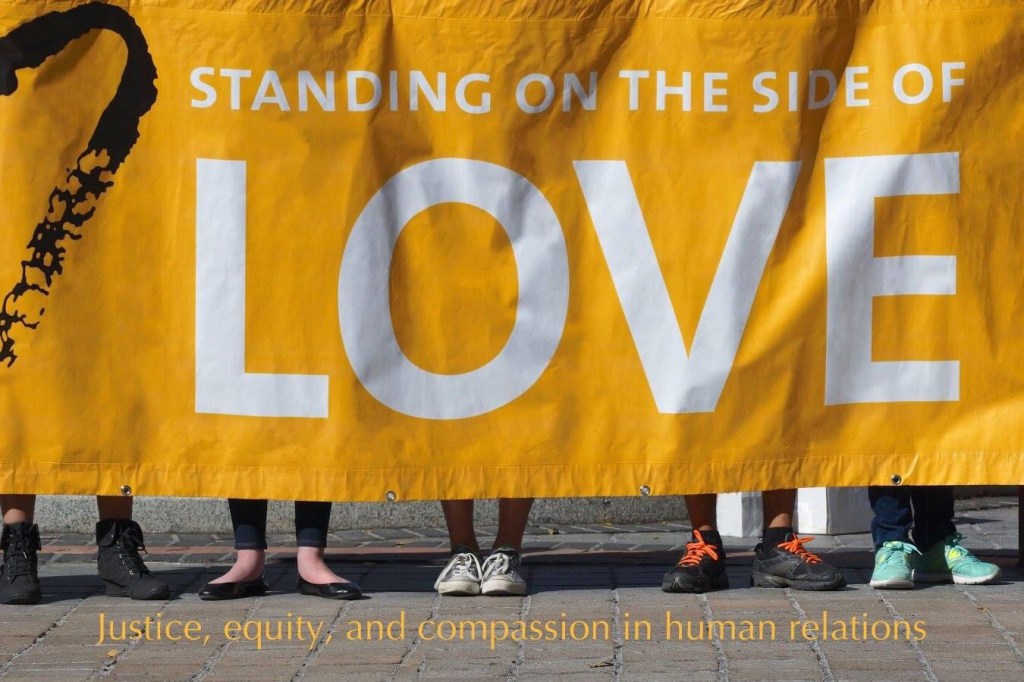
What do we mean by justice and equity and how are they related to our expression of compassion within community?
In her reflections on the second principle of Unitarian Universalism, Emily Gage from Unity Temple in Chicago writes:
Justice, equity, and compassion in human relations points us toward something beyond inherent worth and dignity. It points us to the larger community. It gets at collective responsibility. It reminds us that treating people as human beings is not simply something we do one-on-one, but something that has systemic implications and can inform our entire cultural way of being.
Compassion is something that we can easily act on individually. We can demonstrate openness, give people respect, and treat people with kindness on our own. But we need one another to achieve equity and justice.
Justice, equity, and compassion are all part of the same package. Just as the second Principle overlaps with the first, so it is related to the seventh Principle—the interdependent web of all existence.
Rev. Emily Gage, Unity Temple, Chicago, IL, in The Seven Principles in Word and Worship, ed. Ellen Brandenburg
Recognizing the equality of persons is not enough to create justice and equity. Thomas Jefferson stated that “all men are created equal” even though he really did not mean it given the fact that he enslaved other persons. But even if Jefferson had included women and persons of color in his declaration on equality, that would not insure the cultivation of justice and equity within society.
Focusing on equality of opportunity is also not enough to create justice and equity for all persons. Though the Harvard philosophy John Rawls makes an important point that equality of opportunity is a necessary condition for justice, equality of opportunity will never be a reality unless we recognize and transform the unjust systems that perpetuate much more opportunity for the powerful few over the many and that give so many people a massive head start because of injustices that have often been perpetuated for generations.
True justice requires equity, and cultivating equity means going beyond a transformation of our individual behavior towards one another; it requires the transformation of unjust and inequitable systems that perpetuate the privilege that some people have over other persons in our society. It requires repairing the breach of injustice experienced by so many persons over so many generations that has kept true justice and equity out of reach, especially for the most vulnerable in our society whose backs have been against the wall of injustice for so long. True justice requires not only a leveling of the playing field, but a realization that some people will require more help, preparation, and assistance to even get on the playing field in the first place.
Sadly, our inability to make justice a reality in our society stems from two very simple yet insidious reasons: clinging to white supremacy and patriarchy. Tragically, much of what passes as Christianity in the United States has become a quasi-religious facade for the perpetuation of patriarchy and white supremacy.
The oft-repeated claim that the United States is a “Christian nation” is rooted in a Eurocentric/Western chauvinism grounded in an adherence to both patriarchy and white supremacy. It is not an accident that such a claim is made most vociferously in the South even though it is not limited to one region of our country.
It is no accident that the most patriarchal religions are the least accepting of persons of different sexual orientations or gender identities. Protecting the power and position of clearly defined maleness is a patriarchal priority as is keeping women from being elevated to the highest positions within the religious hierarchy, including the pulpit.
The protection and perpetuation of patriarchy are key factors behind the ongoing efforts to control women and their bodies and their reproductive health choices, and adherence to both patriarchy and white supremacy are driving the attacks against systemic efforts to promote diversity, equity, and inclusion within our society.
The governor of Oklahoma announced this week that all state funding will be removed for DEI offices and programs at public colleges and universities. Oklahoma state superintendent for public instruction in Oklahoma has also made eliminating DEI programs a primary focus of his time in office. The state superintendent has even suggested that the Tulsa Race massacre of 1922 was not primarily about race. It is not surprising that both the Oklahoma governor and state superintendent come from extremely patriarchal religious traditions.
In the midst of the many attacks on diversity, equity, and inclusion; we must remain vigilant to continue working and striving for justice and equity, and as the second principle of Unitarian Universalism reminds us, our work for justice and equity is an expression of compassion grounded in a deep and powerful love for one another. Compassion grounded in love is the motivation that drives the movement towards justice
The justice we seek includes social justice, economic justice, and environmental justice. It is justice for all persons and for all life, and the ultimate goal of our work for justice, equity, and inclusion is the creation of Beloved Community, but to get there, we must break patriarchy and break white supremacy.
 One World House - Mark Davies