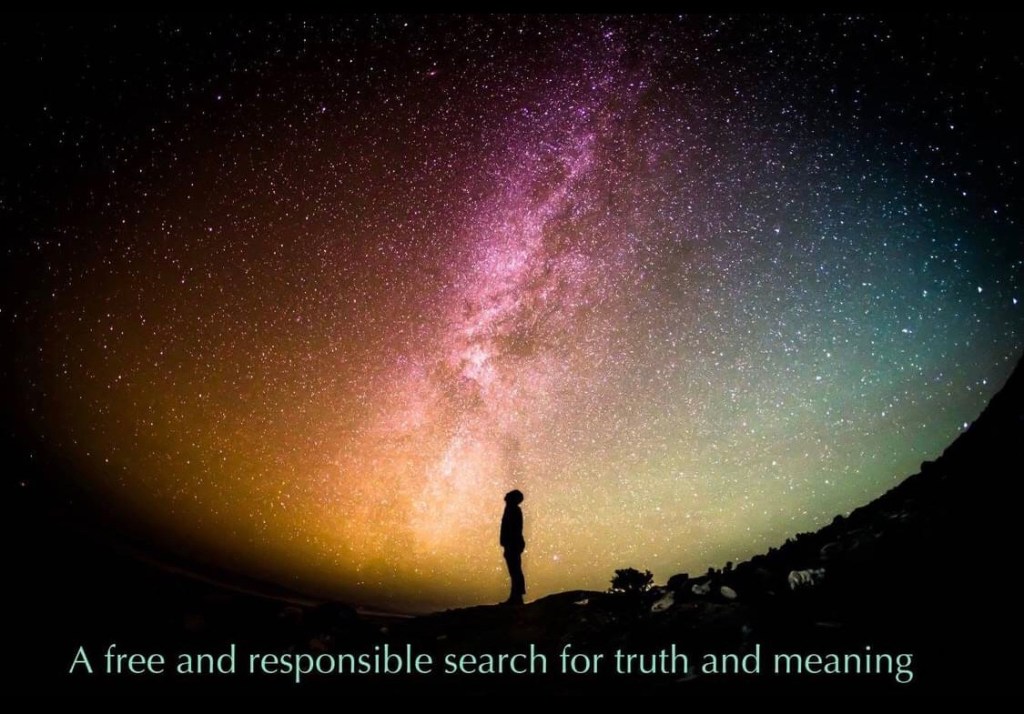
It is important to be open to the truth wherever it may be found, but what is the truth and how do we know when we find it? Is the meaning of our life something that is given to us, or do each of us create our own meaning for ourselves? A free and responsible search for truth and meaning involves asking these questions for ourselves and coming to our own conclusions based on the best evidence and experience available to us.
A beloved community does not prescribe a truth and meaning that you have to accept; it accepts you and supports you in your own “free and responsible search for truth and meaning” (UU 4th Principle). In contrast to this, enforcement of religious doctrinal purity is a form of mind control with the intent to manipulate persons into unity through the elimination of diversity of thought. It is not conducive to fostering a beloved community of free and thoughtful persons.
Religion ought to connect us, not control us. If religion is to have an overall positive influence on the cultivation of beloved community in our world, it will not be done through enforcing doctrinal orthodoxy, but through encouraging love and justice for all persons and all life.
A beloved community is not about conformity of belief, but about everyone belonging in the community and being treated justly no matter how they orient themselves to religion. I experience it to be a gift that my family and close friends orient themselves to religion differently than I do. I want them to find their own meaning for their lives and to explore their own understanding of that which is of ultimate concern to them. The freedom to search for truth and create meaning for oneself while doing no harm to others should be protected as a universal right of all persons.
In her book The Ethics of Ambiguity, Simone de Beauvoir writes, “to will oneself free is also to will others free.” Freedom, including the freedom to search for truth and meaning, comes with responsibility. A responsible search for truth and meaning at a minimum entails doing no harm to others, and ideally it would include doing positive good in relation to others. Doing no harm and doing positive good in relation to others includes willing them to be free just as we will ourselves to be free. Just as we want others to respect our free and responsible search for truth and meaning, so too should we respect their free and responsible search for truth and meaning. This respect for the freedom of others calls us to be in solidarity with the oppressed and to actively pursue their liberation.
The enforcement of doctrinal orthodoxy is a threat to the free and responsible search for truth and meaning. It presumes that we as finite persons are able to know with certainty truths about the Infinite and the Ultimate and that all others must conform to our doctrines to experience salvation. This is the opposite of the humility that is necessary for us to grow in our understanding of each other and the cosmos in which we live, and move, and have our being. It leads to conformity and control rather than love, freedom, and justice in beloved community.
When we tell our children and others in our religious communities that they have to believe or behave in a certain way to be saved, we are telling them that being fully loved and accepted is conditional. This may not be our intention, but this is the message that is received. Religious experience in such a context of enforced doctrinal purity becomes tied to a fear of losing community, a fear of death. and a fear of condemnation. It stifles free thinking, religious imagination, creativity, and our ability to cultivate empathy for persons who think and believe differently than we do. This lack of empathy for others can easily devolve into both fear and hatred of the “other.” It often tends towards the oppression of persons with other religious views, sometimes violently so.
It is not an accident that religious communities that enforce doctrinal purity and suppress a free and responsible search for truth and meaning are historically and currently resistant to the scientific method and to the growth in our understanding of each other and the world that it provides. Religious communities that have promoted doctrinal orthodoxy resisted Copernicus, Galileo, and Darwin; and today, with some exceptions, they are the most likely communities to reject climate science.
When we encourage persons to pursue a free and responsible search for truth and meaning, it is not only good for them; it is good for the well-being and flourishing of our communities. It enables us to experience the fruits of progress that can come from the freedom to pursue new knowledge and understanding of the world in which we live.
I think if we are honest with ourselves, the desire we have for others to share the same views about truth and meaning that we have is motivated more by our own insecurities than by a concern for others. The more people who think and believe like we do, the more affirmed we feel that that we are right in our beliefs and the more assurance we feel in our own salvation.
This desire for assurance of our own salvation is deeply rooted in one of the worst theological concepts ever created – the idea of hell, that place of eternal and unremitting torment and punishment. The fear that this concept generates and the control and power it gives religious and political authorities over our lives are the main drivers of conformity of belief and practice in our religious communities. Hell is a friend to conformity and control and an enemy of freedom and diversity. Unity based on conformity and the fear of hell is oppressive to freedom and the human spirit.
The good news is that hell is just a concept of our own making, and it need not continue to imprison us. We are loved and accepted as we are, and the we have nothing to fear from a free and responsible search for truth and meaning, even if it means we don’t all think and believe the same way. In beloved community, freedom and diversity are values to be embraced, not suppressed. In beloved community, we do not all need to think alike to love and accept each other as persons, and this is why Unitarian Universalists support one another in the free and responsible search for truth and meaning.
 One World House - Mark Davies
Thanks for the work you do!