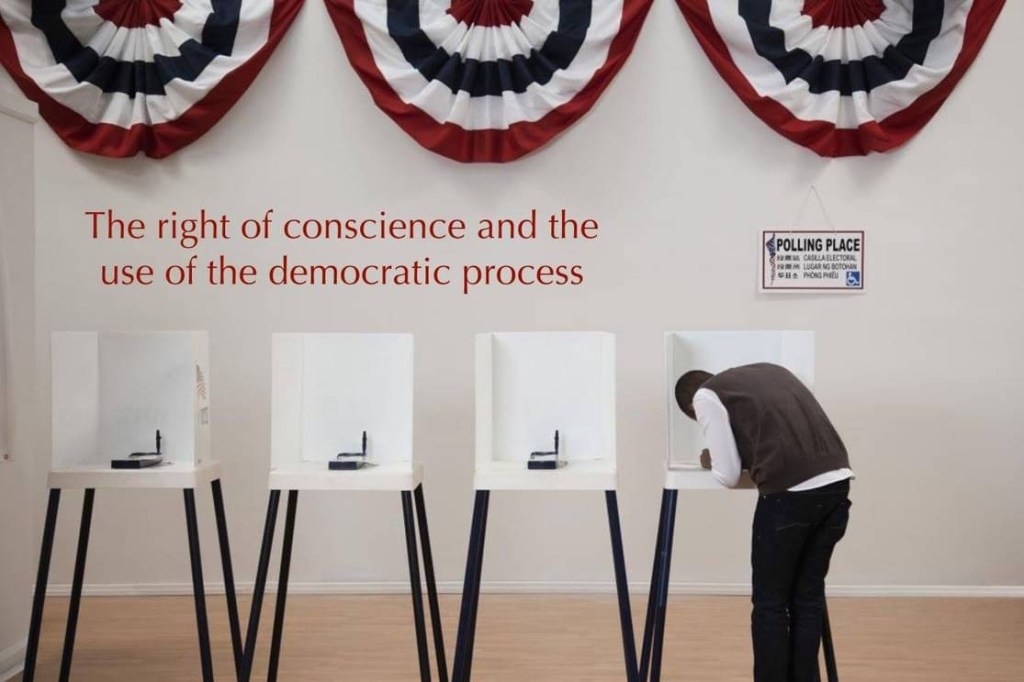
In our religious lives, the democratic process requires trust in the development of each individual conscience—a belief that such development is possible for each of us, as well as a commitment to cultivate our own conscience. We could call it a commitment to the value of each person. In the words of Theodore Parker, ‘Democracy means not “I am as good as you are,” but “You are as good as I am.”’ My connection with the sacred is only as precious as my willingness to acknowledge the same connection in others.
Rev. Parisa Parsa, in The Seven Principles in Word and Worship, ed. Ellen Brandenburg
Given the overwhelming evidence that communities with vibrant participatory democratic processes in which the value and conscience of all persons are respected are the most just, peaceful, flourishing, and sustainable communities in the world, it is important to reflect on how we can model the importance of the right of conscience and participatory democracy in our society where so many persons seem drawn to autocratic leaders and practices.
When we look to see who the historical and contemporary detractors of democracy are, we find that they are typically persons of wealth and power who want to control the political landscape to maintain and expand their wealth and power. Given the influence of power and wealth on politics, it is no wonder that many well-known political philosophers promoted and perpetuated anti-democratic political perspectives.
The more I read Plato (423-347 BCE) and Aristotle (384-332 BCE), the more struck I am by how their positions of power and privilege influence their philosophies, especially when it comes to their political views and their criticisms of democracy. Plato believed that a monarchy was the best form of government and that only philosophers should be kings because only philosophers had access to true wisdom and the knowledge of the eternal Forms of Goodness and Justice that one needs to rule a society. Aristotle argued that only persons who have the leisure time to cultivate both moral and intellectual virtues should participate directly in political processes, thus precluding the full political participation of the vast majority of persons in the society of his time.
Unfortunately, Plato’s and Aristotle’s anti-democratic perspectives carried over into Christian political thought owing to Plato’s and Aristotle’s influence on Augustine and Aquinas respectively.
Augustine (354-430 C.E.) and Thomas Aquinas (1225-1274) were two of the most influential apologists for the Church’s acceptance of the autocracy of empire, and they used the philosophical framework of Plato through Plotinus in the case of Augustine and the philosophical framework of Aristotle in the case of Aquinas to make their case for acceptance of autocracy over democracy.
Even though Christianity accepted and was compromised by autocracy before Augustine and Aquinas by the Emperor Constantine, the anti-democratic influence of Plato and Aristotle on Augustine and Aquinas still plays a role in developing and perpetuating Christian political thought that is supportive of autocracy. Thus, it should not come as a surprise that many of the autocratic movements in the Western world are cloaked in Christian language and thought that is supportive of autocracy.
Today, the primary drivers of failed democracies are 1) the infusion of money into the political process which gives the wealthy disproportionate power and influence, 2) the belief that some persons or groups of persons are of less value than some other persons or groups of persons, and 3) diminished economic and educational opportunities for significant portions of the population owing to 1 and 2.
More simply put, autocrats make use of their wealth and power to gain, maintain, and expand their power while using religion and race to pit people against each other as a way of distracting them from the real reasons for their diminishing economic opportunities and political influence. By getting us to point the finger of blame for our problems at one another, the autocrats more fully consolidate their own wealth and power. This is not true freedom, and though it may be disguised as democracy, this is actually what oligarchy looks like.
Throughout history and to this day, there are those who argue against democracy owing to the fact that many persons are “not educated enough” to participate responsibly in democratic processes. This, however, is not a problem with democracy; it is a problem of cultivating the societal will to create systems by which all persons have equitable access to the education that helps responsible democratic participation to flourish. Today, many who make the “lack of education of the masses” against democracy are the same persons creating barriers for equitable access to high quality public education. A society that gives up on public education is giving up on democracy.
Often those who call out the loudest for “freedom” are the least willing to protect the conditions that will allow for true and enduring freedom to exist in a society. You cannot have real freedom without freedom of conscience, and you cannot have freedom of conscience without freedom of religion. You cannot have freedom of religion without the separation of church and state, which includes not doing anything to establish one religion as the religion of the state. Thus, those who call for “freedom” while also calling for us to be a Christian nation are actually undermining the most important conditions for freedom in our society. Christian nationalism and true and enduring freedom are contradictory propositions.
A vibrant and enduring democracy is not possible in a society that does not protect the freedom of conscience to orient oneself to religion as one sees fit as long as such religious orientation is expressed in ways that do not harm others.
The case for freedom of conscience expressed through democracy is strong. Throughout the world, the evidence shows that there is a clear correlation between vibrant democracy and human and ecological flourishing. Vibrant full democracies are happier, healthier, better educated, less corrupt, more equitable, more participatory, more just, and more peaceful than flawed democracies and societies with autocratic forms of government.
While it is true that not everyone gets what they want within a democracy; it is much more likely that they will get what they need to flourish as persons within a community where each person’s freedom of conscience is respected and persons are empowered to express themselves as persons of equal value within the democratic process. In other words, in a democracy “you cant always get what you want, but if try sometimes you’ll find you get what you need” or something like that. Respecting the freedom of others and treating each other as persons with equal and inherent worth – this is what true and enduring freedom looks like. When Unitarian Universalists affirm “the right of conscience and the use of the democratic process within our Congregations and in society at large,” we are affirming a right and a process that help us all make progress together toward beloved community.
 One World House - Mark Davies