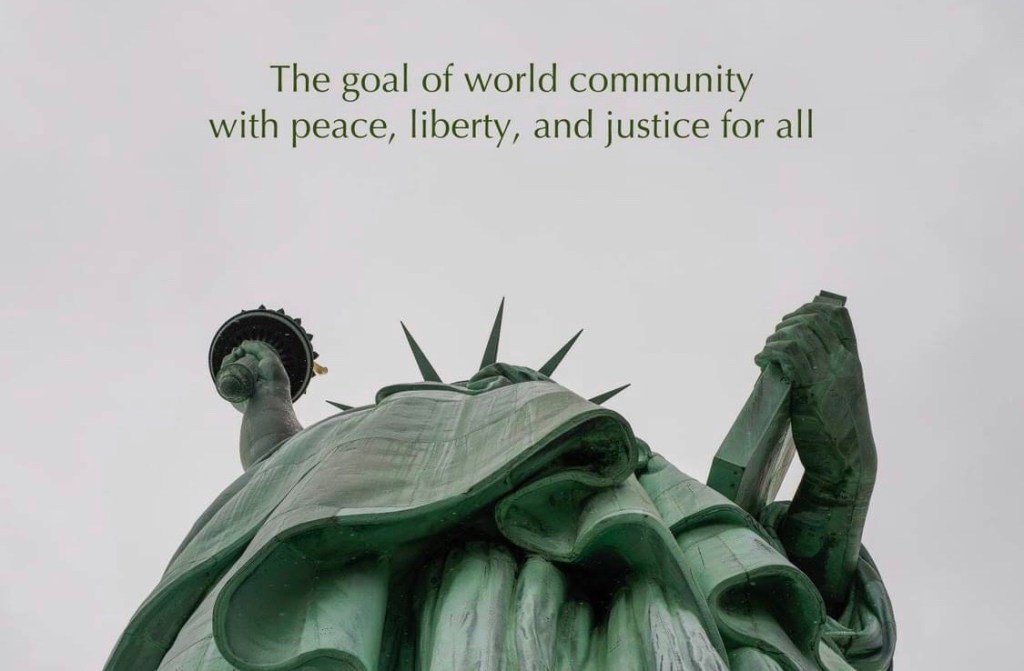
How can humanity more fully see ourselves as part of a world community of persons of equal inherent worth and more effectively work together to address the global challenges we face and create a more peaceful, free, and just existence for all? What would it take for humanity to see ourselves as one beloved community on earth rather than as competing nations who seek benefit from diminishing one another?
For most of human history, lack of technology in transportation and communication made it unnecessary to think of ourselves as members of a world community. We were divided by distances and differences that made world community impossible, but today the cultivation of world community has become a necessity if we are to addresss all of the challenges that require our global cooperation. We now truly live in a world where Martin Luther King Jr.’s words ring true: “Injustice anywhere is a threat to justice everywhere” (Letter from Birmingham Jail).
The most pressing challenges facing humanity require that we see ourselves as a world community cooperating with each other for the flourishing of all. We cannot afford to be enemies of each other in a world in which we have the military means to destroy the planet and in which we are threatening a livable climate in our one world house, our only home.
If world community is an important and perhaps even necessary goal for humanity; what then are the cultural, economic, and political conditions that would allow for a free, just, peaceful, and sustainable world community to flourish?
Looking first at culture, world community will not be established through forced global cultural homogeneity. A just and beloved world community requires both the acceptance and protection of cultural and religious pluralism as long as the cultural and religious expressions are doing no harm and are not denying persons of basic human rights. Freedom of religious and cultural expression does not equate to a right to treat persons of other religious and cultural orientations as being of less value or as having fewer rights within society.
We must find ways to move beyond all forms of religious nationalism if we are to build a world community in which sustainable peace is possible. The premise that persons of certain religious orientations have more value or should hold more rights within a nation than persons of other religious orientations is the antithesis of just and beloved community.
Economically and politically, one of the most important steps towards just and peaceful world community is to focus on cultivating sustainable and self-sufficient local communities. Strong and sustainable local economies within the context of bioregional self-sufficiency decrease dependency on other parts of the world for our food and fuel, thus reducing the risk of conflict with other regions.
It is important not to confuse world community with a world government that dictates its will globally. Most political decisions are best left to the democratic participation of persons in local and regional communities. However, we do need to find ways to interact globally that are not dictated by a handful of global superpowers so that we may move towards a reality in which all persons on the planet are treated justly and equitably.
Living into true and sustainable world community requires a recognition that we are not only part of the human community, but also the ecological community of all life. Clean air, clean water, healthy oceans, habitat for wildlife, preservation of biodiversity, and protection of a livable climate are all necessary for the world community of all life to flourish.
Finally, and this is especially relevant for us here in the United States, the cultivation of world community requires that all of humanity give up on militarism as a way of enforcing our will and expressing our economic hegemony in the world. Many of the global challenges we face could be solved by spending a fraction of the amount that we currently spend on the weapons and ways of war on projects and programs to eradicate poverty and reverse ecological degradation. Additionally, our world community will never be truly safe until every nuclear weapon no longer exists, with the possible exception of a few nuclear weapons that might be needed to divert an asteroid that is on a collision path with our planet, at least until better methods of planetary defense can be developed.
Perhaps we in the United States spend so much money on militarism and perhaps we fear the cultivation of world community because deep down we know that we have taken much more than our fair share, and we are afraid that we will have to give up something in order to live in a just and equitable relationship with the rest of the world. We are, however, maintaining a delusional worldview that our long-term prosperity is dependent on controlling the rest of the world with military might. Many an empire has fallen while holding on to such delusions that their power was dependent on taking power from others rather than finding ways to live together in mutually beneficial cooperation and peace.
The sixth principle of Unitarian Universalism is a recognition that the present and future flourishing of humanity and the world community of all life requires an ever-evolving effort for worldwide collaboration and cooperation. It may seem like an overly idealistic goal given the deep divisions and the extreme expressions of religious nationalism that we see in our world today, and as John and Yoko reminded us, “ [many] may say that [we are] dreamer[s], but [we’re] not the only one[s], and [we] hope some day that [all] will join us, and the world will live as one” (Imagine).
Yes, cultivating a world community of all life may be a lofty goal and we will likely never see it fully come to fruition in any of our lifetimes, but anything we can do to move more in that direction moves us closer to realizing the vision of just and beloved community that our world needs so badly. Together, may we make it so.
 One World House - Mark Davies