In a society with deep divisions, some may see pluralism as a problem rather than a strength of our society. In this discourse, I will explore ways that embracing and celebrating pluralism is an important part of bringing healing and regeneration to our communities.
Embracing pluralism is based in a recognition that we don’t have to all think alike, believe alike, look alike, or act alike to be in human community. It is the expression of an awareness that communities are more free and flourishing when everyone is empowered to be fully who they are as long as they are bringing no harm to others.
Most of us want to be free. We want to make choices about our own lives and create meaning and value for ourselves without other people telling us how we should think, believe, or act. Autonomy is a value we don’t talk about much, but when we don’t have it, we definitely miss it.
Despite all of their faults (and there are many), the persons who wrote the Constitution of the United States understood that it was important to build a recognition of the value of autonomy and freedom into the Constitution in what we know as the Bill of Rights.
They recognized that we have different ideas, and we should be allowed to express them through the freedom of speech, and they specifically recognized the importance of the freedom of religion and protected it through the non-establishment and free exercise clauses of the First Amendment. This is the antithesis of Christian Nationalism.
The path of rejecting pluralism ultimately weakens democracies and leads towards autocracy as sameness in thought, belief, and action is enforced throughout society. Rejecting pluralism is a recipe for oppression and persecution of persons who don’t fit in the box of conformity into which a non-pluralistic society attempts to force everyone.
Have you ever been in a situation where you felt like you had to pretend you were someone you were not in order to feel accepted, in order to belong in community? At the very least this experience is uncomfortablle, but in certain contexts and circumstances, it can be soul crushing.
Attempts to promote homogeneity and assimilation as a strategy for strengthening community end up hindering freedom and stifling the human spirit and thus weaken genuine community.
Cultivating beloved community entails avoiding the extremes of radical and unaccountable individualism on one end of the spectrum and autocratically enforced collectivism on the other end. The middle way of pluralistic community empowers diverse persons-in-community to embrace their freedom and their differences in responsible ways that contribute to their own flourishing as well as the flourishing of others.
I have always been drawn to Gene Roddenberry’s vision for pluralistic community that he expressed through science fiction in Star Trek and Star Trek: The Next Generation. Roddenberry’s pluralistic communitarian vision is especially pronounced in The Next Generation as the United Federation of Planets, consisting of a diverse planetary cultures working together for the freedom and well being of all, is often confronted by societies and persons with less just and less responsible ways of relating with one another.
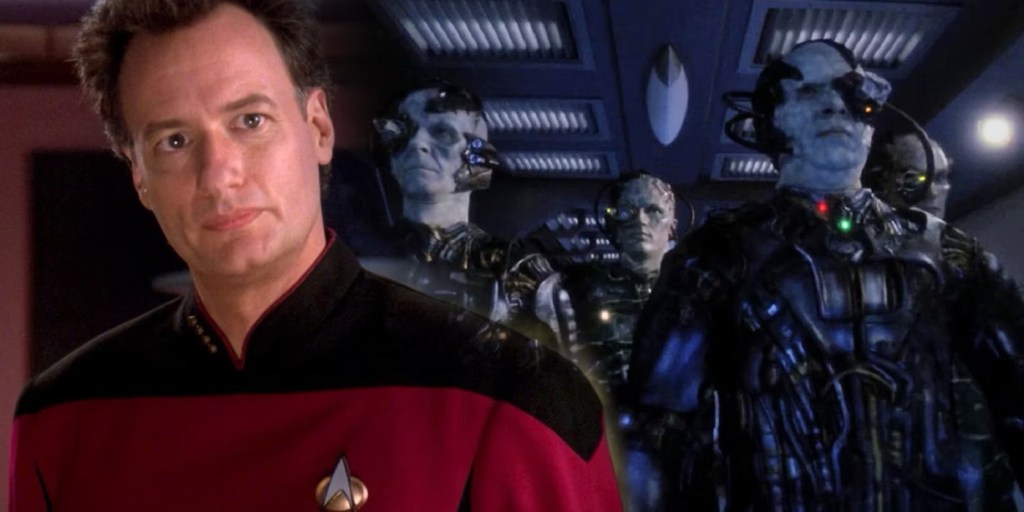
Radical and irresponsible individualism that expresses power without regard to the harm it causes others is represented by Captain Jean-Luc Picard’s nemesis Q, who expresses an almost unlimited individual will to power that wreaks havoc on community. If we were to reflect on Martin Luther King’s querry, “Where do we go from here, chaos or community?” – the way of Q clearly represents the way of chaos.
Extreme collectivism on the other end of the spectrum is represented by “The Borg,” a society that exists and expands through forced assimilation of all persons it encounters by connecting all their minds to one another and forcing all to conform to the will of the whole. To those who resist assimilation, the Borg responds with the warning: “Resistance is futile. You will be assimilated.” In the Borg, all individuality and personal freedom are lost.
In the midst of these two extremes, the Federation of Planets attempts to defend and protect a middle way of responsible pluralism in which persons-in-community not only celebrate their differences, but actually see the pluralism of their community as one of its primary strengths, a society in which person are empowered to express their own will to be free while willing and respecting the freedom of others.
Outside of the realm of science fiction, the importance of embracing pluralism became increasingly clear to me through two life changing experiences in my mid twenties:
In the summer of 1990, during my seminary education at Candler School of Theology, I had the privilege of studying in India for 7 weeks on a study/travel experience led by Dr. Thomas Thangaraj who was the Professor of World Christianity at Candler. We studied Hinduism, the thought of Mohandas Gandhi, the history of Christianity in India, and interfaith dialogue.
As part of our experience, we spent some time with an interfaith dialogue and prayer group that had been meeting once a week for 25 years. It was clear from my observations of this group that they came to the dialogue without hiding their differences or their personal commitments. They were not pretending to all be the same, thus allowing for interaction with each other’s true selves rather than some fake and shallow interfaith facade. This allowed the members of the group to be truly challenged by each other, and that allowed for a deeper mutual understanding and genuine relationships to develop.
Later that same year, in October of 1990, I had another opportunity to witness the value of pluralism when I studied for a semester at the Bossey Ecumenical Institute of the World Council of Churches in Celigny, Switzerland, just outside of Geneva. We were 51 students from 33 countries and 15 different Christian traditions. Though we were all Christians, we were a very diverse group. We lived and studied in a chateau overlooking Lake Geneva with an amazing view of the Alps. In this beautiful setting, we had to squarely confront the reality of our differences before building genuine community. It took time and work for us to listen to and learn from each other and come to a deeper understanding of each other’s perspectives. Over time, by openly sharing our differences and diverse commitments and beliefs, we were able to think more deeply and critically about our own beliefs and ways of being, and we came to a greater appreciation of each other. By the end of our semester together, this pluralistic community proved to be one of the deepest and most meaningful experiences of intentional community in my life.
The value of pluralism is that we are all encouraged to be true to ourselves and to have the freedom to create our own meaning and values while respecting the freedom and rights of others to do the same. Embracing pluralism alone may not enable our communities to “boldly go where no one has gone before,” but it just might be a key factor in keeping us on the path to beloved community, and that is a good direction to be going.
 One World House - Mark Davies