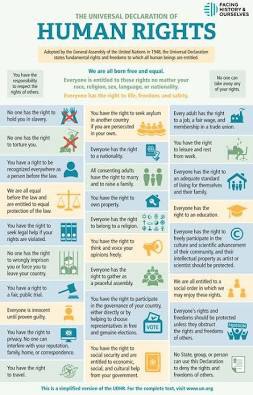
We hear a lot of talk about the rights granted by the United States Constitution, but even more fundamental than our constitutionally guaranteed rights are our universal human rights that are shared by every person on earth and ought to be respected by all persons whether one is a citizen of the United States or not.
I deeply appreciate the philosopher Immanuel Kant’s moral claim that we have duties in relation to one another based on our experience that all persons have inherent worth and dignity that ought to be respected. It was this insight that became the core principle of the United Nations Universal Declaration of Human Rights. I would also expand this sense of duty to include moral obligations in relation to non-human animals as well.
Immanuel Kant rightly recognized that the moral use of freedom requires responsibility to others. He understood that we have a duty to treat persons as ends and never simply as means. In a world in which we often treat so many persons as objects or as things for our use, we have a great deal to learn from Kant’s view that we have a moral duty to always treat each other as persons.
The Universal Declaration of Human Rights – 1948 – was drafted by a United Nations committee chaired by Eleanor Roosevelt. The Declaration claimed that human rights are based on the recognition of inherent dignity and worth of human persons. Human rights are seen as “the foundation of freedom, justice and peace in the world” (Preamble).
In 1948, the world had just witnessed the evil that occurs when there is disregard for human rights. There was general agreement that there was a need for rights to “be protected by the rule of law,” that there should be equal rights for all persons, and that rights are linked to freedoms (Preamble).
The United States ratified the Universal of Declaration of Human Rights in 1948, but we are currently so grossly out of step with its spirit and letter as to make our ratification of the document a total sham. The rights that the declaration upholds are not being respected by the government of the United States. We have lost our way. The Universal Declaration of Human Rights of 1948 was written and ratified with the intention of curbing the kind of blatant disrespect for human rights that we are currently witnessing here in the United States.
Over the past week, I took the time to re-read the 30 Articles of the Universal Declaration of Human Rights to see just how badly the United States is currently out of compliance with the key provisions of the Declaration, and it was shocking to to see that not only are we not in compliance with some of the Articles, but we are actually out of compliance with the majority of the Articles in the Declaration. Not only that, but the rhetoric and actions of our current regime are antithetical to the spirit of the Declaration as a whole. Given the leadership that the United States took in the drafting and ratifying of the Declaration, it is tragic to see us moving further and further away from its aspirations of preserving human rights for all persons regardless of their social or national origin.
I am highlighting here the Articles of the Declaration that I see the United States most clearly and egregiously violating:
The Declaration of Human Rights calls for no one to “be subjected to torture or to cruel, inhuman or degrading treatment or punishment” (Article 5). It proclaims that “Everyone has the right to recognition everywhere as a person before the law” (Article 6), and that “All are equal before the law and are entitled without any discrimination to equal protection of the law (Article 7). Is the United States of America upholding these human rights that we have promised to uphold?
The Declaration asserts that “No one shall be subjected to arbitrary arrest, detention or exile” (Article 9) and that everyone “is entitled to a fair and public hearing by an independent and impartial tribunal” (Article 10). Is the United States of America upholding these human rights that we have promised to uphold?
Article 12 asserts that “no one should be subjected to arbitrary interference with [their] privacy, family, home or correspondence….” Article 13 calls for “the right to freedom of movement and residence within the borders of each state.” Article 14 asserts “the right to seek and to enjoy in other countries asylum from persecution.” Is the United States of America upholding these human rights that we have promised to uphold?
Article 18 declares that “everyone has the right to freedom of thought, conscience and religion…”, and Article 19 declares that “everyone has the right to freedom and expression….” Article 20 proclaims “the right to freedom of peaceful assembly.” Is the United States of America upholding these human rights that we have promised to uphold?
Article 23 declares the rights of “equal pay for equal work,” the right of a living wage, and the right to form and join unions. Article 25 declares “the right to a standard of living adequate for the health and well-being of [persons] and of [their] family.” Article 26 declares that “everyone had a right to education.” Article 27 declares that we all have “the right freely to participate in cultural life of the community, to enjoy the arts and to share in scientific advancement and its benefits.” Is the United States of America upholding these human rights that we have promised to uphold?
In stark juxtaposition to the principles of the UN Universal Declaration of Human Rights, the current presidential executive orders and actions of the United States express through word and deed a declaration of anti-human rights. Tragically, as has so often been the case throughout history, much of Christianity, the dominant religion in our culture, is being co-opted by those who are ignoring and trampling on the human rights of others, in direct opposition to the love and justice espoused by Jesus.
By ignoring the rights of all persons guaranteed by the Constitution of the United States we are breaking our promise to ourselves. By ignoring the rights of all persons expressed in the Universal Declaration of Human Rights, we are breaking our promise to the world. Our work today is the work of restoring our promises to guarantee and protect the human rights of all persons and to repair the systems that are not properly upholding those rights. This is our sacred task.
If you find the writings at One World House by Mark Davies helpful or inspiring, you can show your support by making a contribution using Venmo or Patreon or PayPal
 One World House - Mark Davies
We agree . Rev.Dr Gezu Mossissa From Ethiopia