So much of how we define success and well-being in our society revolves around the money we make and the things we accumulate, and it is clear this acquisition and consumption culture where the quantity of stuff counts more than the quality of our relationships is leading to a dead end for humanity. How can we move away from an overemphasis on acquisition, accumulation, and consumption and move towards a life of qualitative meaning and purpose?
During my mid twenties, I developed an interest in European literature while I spent two years studying in Switzerland, England, and Germany. Dostoyevsky, Kafka, Camus, Orwell, and Tolstoy were among my favorites.
This was was not light reading, to put it mildly. These authors were addressing some of the most troubling aspects of the human condition in their writings. Whether they were writing about human suffering, violence, war, religious conflict, evil, or greed; they were wrestling with the factors of human life that have contributed to horrific suffering throughout human history.
During my studies in Europe, I was particularly drawn to Leo Tolstoy because of his influence on the thought of Mohandas Gandhi, and I came across a short story by Tolstoy titled “How Much Land Does a Man Need?”
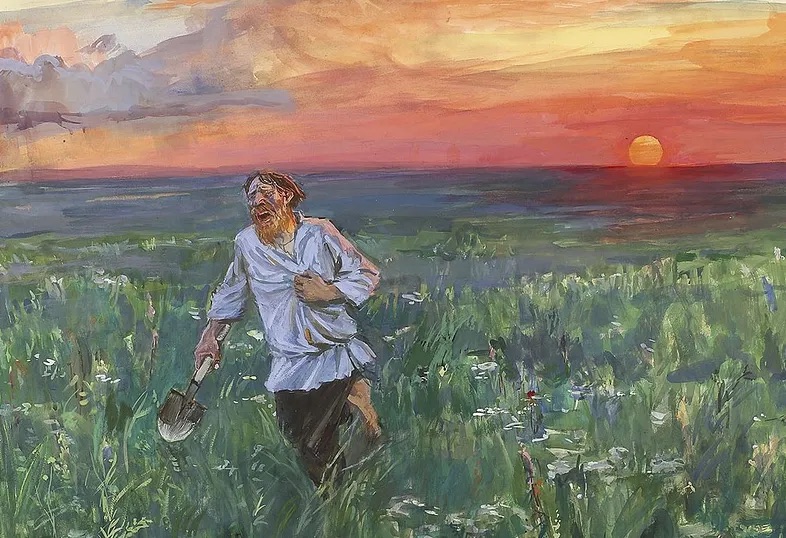
The story is about a man named Pahom who is a Russian peasant who becomes consumed by greed. He is driven to accumulate as much land and wealth as possible, and he is obsessed with outdoing others.
Pahom learns that the Bashkirs (a Turkic ethnic group indigenous to Russia) are selling large amounts of land at a very low price, but there is a condition to claiming the land. He can only claim the amount of land that he can circumnavigate by foot between sunrise and sunset. Pahom is so driven to claim as much land as he possibly can in one day that he walks such a great distance that he collapses and dies at sunset just as he completes his arduous journey.
It turns out Pahom ultimately only needed the amount of land necessary for his premature burial precipitated by his greed and desire for acquisition and accumulation. In the end, his quest for more diminished his life to the point of actually ending it.
Tragically, we continue to see many persons who have not learned from Pahom’s lesson and who can’t ever seem to get enough wealth, power, and prestige to satisfy their desires. Tragically their greed and insatiable appetite for more than they will ever need not only diminishes the true quality of their own lives, but it also diminishes the lives of others and contributes to the suffering of the most vulnerable among us.
Whatever the definition of evil is, it most certainly includes billionaires making their money off life-destroying activities and then hoarding their wealth while the most vulnerable in the world suffer the consequences of their greed.
For all of its flaws as a nation, up until 2025 the United States through USAID was playing a significant role in controlling preventable and deadly diseases and in preventing famine thoughout the world. Then the most corrupt president in American history gutted USAID on advice from the wealthiest man in the history of the world, putting millions of lives at risk, and already leading to hundreds of thousands of unnecessary deaths. This is what evil looks like.
On our current trajectory, the epitaph for humanity may one day read:
A few members of the species Homo sapiens refused to give up making trillions of dollars from actions that made Earth unlivable for the species as a whole and for millions of other species of life, thus precipitating a global mass extinction event. If intelligent life evolves again and translates this message, please heed this warning.
For all the vast differences in intelligence between humans and dinosaurs, the dinosaurs’ layer in the geological record will be much thicker than ours, and their demise was not of their own making because they never ‘evolved’ to be so greedy that making money became more important to them than the survival of life on Earth.
What we must come to understand is that expressing empathy is not a problem, but is rather the antidote to the numerous societal and ecological ills we are currently experiencing. We do not have too much empathy as the least empathetic among the billionaires have claimed. On the contrary, we actually have an empathy deficit among with a corresponding deficit of love and community; and that is where we all must come into the picture. Our love for humanity and our love for all life call us to cultivate empathy and practice justice for all within beloved community, and if we are intentional about doing that work together, we may not always get what we want, but we just might find we get what we need, and that is enough – enough for us and enough for the community of all life on Earth.
If you find the writing at One World House by Mark Davies helpful or inspiring, you can show your support by making a contribution using Venmo or Patreon or PayPal
 One World House - Mark Davies