Take a stroll down climate change memory lane with me. The year is 1988, and in addition to being the year I graduated from college, it is also the year that climate scientist and director of NASA’s Goddard Institute for Space Studies James Hansen testified before the United States Senate Committee on Energy and Natural Resources. And this is what Hansen said in his testimony on June 23, 1988 – over thirty seven years ago:
“Global warming has reached a level such that we can ascribe with a high degree of confidence a cause and effect relationship between the greenhouse effect and observed warming…It is already happening now… The greenhouse effect has been detected and it is changing our climate now…We already reached the point where the greenhouse effect is important…”
Hansen also said that “with 99 percent confidence we can state that the warming during this time period is a real warming trend.’ (see https://pulitzercenter.org/sites/default/files/june_23_1988_senate_hearing_1.pdf).
In 1988, the world was fresh off a successful global effort to address damage to the ozone layer that led to the Montreal Protocol on Substances That Deplete the Ozone Layer in 1987, and there was initially bipartisan support for responding to the threat of climate change. In 1988, while campaigning for President, George H. W. Bush even said: “Those who think we are powerless to do anything about the greenhouse effect forget about the ‘White House effect. As president, I intend to do something about it” (https://www.nytimes.com/1989/05/09/opinion/the-white-house-and-the-greenhouse.html).
The 20th anniversary of Earth Day in 1990 was met with great enthusiasm and commitment to care for the environment and urgently address the problem of climate change, and the United Nations was taking the lead to organize global efforts to promote ecological sustainability and avoid catastrophic climate change that led to Earth Summit in Rio in 1992.
Although I had a great appreciation for nature since my early childhood, It was during this time between 1988 and 1992 that I became immersed in the environmental movement and began focusing my masters studies and then doctoral studies on theological, philosophical, and practical responses to our global ecological challenges, including the threat of catastrophic climate change.
During this time I read the ecological theology of the United Methodist process theologian John B. Cobb Jr., the report of the United Nations Brundtland Commission titled Our Common Future published in 1987, and the political reflections on how to address climate change found in Al Gore’s 1992 book titled Earth in the Balance.
But by 1992 something had changed. The bipartisan commitment to address the threat of climate change that was emerging in 1988 had been greatly diminished by 1992. As climate scientists were reaching global consensus about the causes of of climate change and the urgent need to address the climate crisis, fossil fuel companies were coming to their own consensus that it was in their financial interests to deny the reality of climate change as long as possible and to spend billions of dollars spreading misinformation and disinformation about climate change and influencing politicians through donations and lobbying to promote fossil fuel interest in order to protect the $trillions of dollars in assets that they owned that were still in the ground and that could only make them money if they were extracted and burned. The Greenhouse Effect and the promised White House effect to address it were becoming overshadowed by the Greenback Effect fueled by the greed of the Fossil Fuel Industry.
By 1992, it was becoming very clear that the needed transition away from fossil fuels would not happen smoothly. It would not happen without a struggle, it would not happen without a fight with the fossil fuel companies and their oligarch executives who were determined to extract and cash in on their hydrocarbon assets even if it meant hurling human civilization towards climate chaos.
Tragically, the fossil fuel industry, with its vast resources and political influence, has been immensely successful at keeping humanity from doing what we ought to do to address the existential threat to human civilization that is posed by the climate crisis. They have managed to keep humanity slow walking the urgent energy transition that is needed to preserve a livable climate for all.
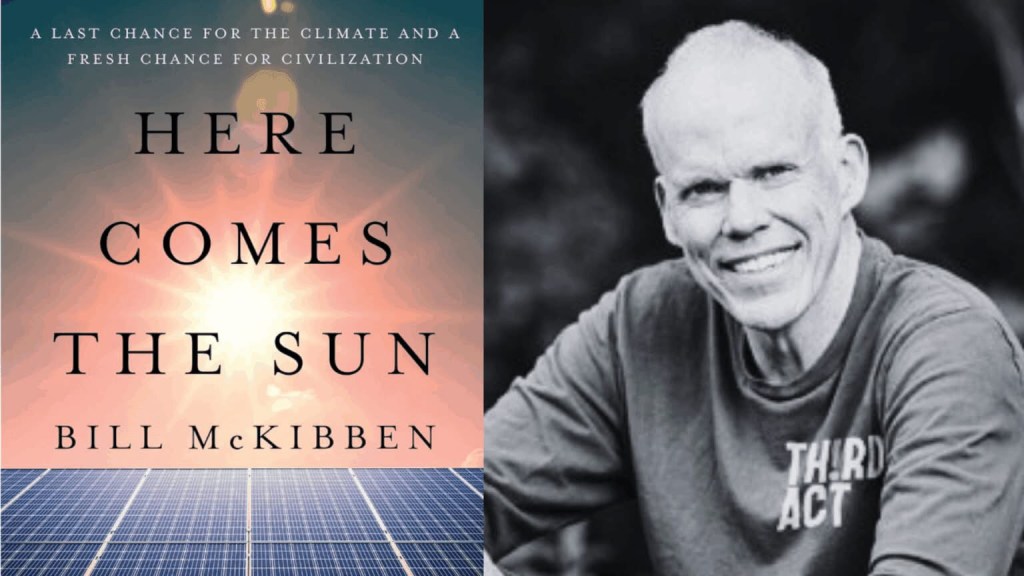
There are few people on earth who have done more to take up the necessary fight against the propaganda of the fossil fuel industry than Bill McKibben (also a United Methodist) who wrote the first book on climate change for a general audience titled The End of Nature that was published in 1989 – a year after James Hansen’s testimony before the Senate in 1988.
“Bill McKibben is founder of Third Act, which organizes people over the age of 60 for action on climate and justice. [After his 1989 book The End of Nature] He’s gone on to write 20 books, and his work appears regularly in periodicals from the New Yorker to Rolling Stone. He serves as the Schumann Distinguished Scholar in Environmental Studies at Middlebury College, and he has won the Gandhi Peace Prize as well as honorary degrees from 20 colleges and universities. He was awarded the Right Livelihood Award, sometimes called the alternative Nobel, in the Swedish Parliament….
“McKibben helped found 350.org, the first global grassroots climate campaign, which has organized protests on every continent, including Antarctica, for climate action. He played a leading role in launching the opposition to big oil pipeline projects like Keystone XL, and the fossil fuel divestment campaign, which has become the biggest anti-corporate campaign in history, with endowments worth more than $40 trillion stepping back from oil, gas and coal.” (see https://billmckibben.com/bio/)
Bill McKibben has been on the front lines of this battle for our climate future for decades, and he is not known for being particularly optimistic about where we are headed. In fact, he is more known for his “dark realism” as he lays out in sometimes very frightening detail what will happen if we don’t do what we must do to avoid climate chaos. After all, optimists do not tend to title a book The End of Nature.
But Bill McKibben is non-characteristically optimistic in his most recent book Here Comes the Sun: A Last Chance for the Climate and Fresh Chance for Civilization. Advances in the production capacity and efficiency of solar power have brought us to a watershed moment in which solar and wind power and the battery storage technology needed to support them have reached the point where it is significantly less expensive to use these forms of energy rather than fossil fuels.
We now have the technological ability and the production capacity to power the planet with solar and wind and to transition away from fossil fuels at the pace that is needed to avoid catastrophic climate change, and there is no compelling reason not to do this! One of the only things keeping us from doing this is the fact that the fossil fuel companies still want to make $trillions of dollars off of their yet to be exploited fossil fuel assets still in the ground. The two main things keeping us from a renewable energy future and a livable climate are greed and the lack of political will that is reinforced by that greed.
One of the great advantages of solar and wind power is that their use in distributed forms makes it difficult for corporations to concentrate the profits of solar and wind in the hands of a few, which is one of the main reasons fossil fuel companies are doing all they can to resist the needed transition. The good news, the really excellent news, is that we are seeing significant signs of the needed transition happening around the world in spite of the efforts by fossil fuel companies to stop it. The low cost and efficiency of solar and wind power and battery storage technology are such that it no longer makes sense to develop an economy using fossil fuels. The time to leapfrog fossil fuels in favor of solar and wind in developing economies has come – here and now.
Yes, like all forms of energy, there are environmental costs to solar and wind power and the batteries needed to support them. As McKibben notes, “We need lithium, copper, rare earth minerals like neodymium—these are the elements that allow sunlight and wind to be translated into energy we can use.” This requires mining and refining that have an environmental impact, but when you compare this impact with the overall impact of fossil fuels, there is really no comparison when it comes to the overwhelmingly more negative consequences of continuing to extract and burn fossil fuels. Not only that, with new advances in technology and recycling, the need for mining will actually decrease rather than increase over time. And the recent breakthroughs in the use of sodium for batteries is a truly significant positive development.
I have known Bill McKibben tor decades, and I know that he does not shy away from telling it like it is, and if recent developments in solar and wind and battery technology are making a dark realist like Bill McKibben feel optimistic about our climate future, then I am listening and I am hopeful that here comes the sun to save a livable climate for us all, that is if we can break away from the hold that a fossil-fueled fascism currently has over our country. May we all find the courage and commitment to do all we can to let the sun come in.
If you find the writings at One World House by Mark Davies helpful or inspiring, you can show your support by making a contribution using Venmo or Patreon or PayPal
 One World House - Mark Davies