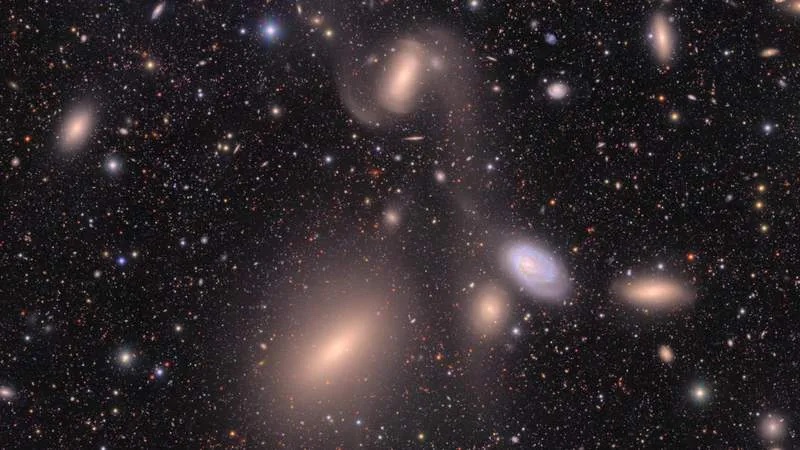
Given that there are 2 to 6 trillion galaxies in the known universe and that there are often hundreds of billions of stars in each galaxy and that there are estimated to be hundreds of billions of planets in our galaxy alone and that it only took about 500 million years after our planet cooled and stabilized for life to develop on Earth, the chances that we are the only life in the universe are extremely minuscule.
Over the past five years, the James Webb Space Telescope has made it possible for us to identify thousands of exoplanets (planets that orbit a star outside of our solar system), many of which are candidates for the existence of possible life given their locations in the habitable zones around their suns. We have recently begun to be able to analyze the chemistry of the atmospheres of some of these exoplanets, and we may be getting very close to detecting biosignatures on some exoplanets that indicate the presence of life. With the recent launch last month of the Nancy Grace Roman Space Telescope into space (a telescope more powerful and with a greater field of vision than any existing telescopes), we will soon have an even more powerful instrument of observation to investigate the presence of life on these exoplanets, and even on exomoons.
I have had the privilege of speaking with some of the top scientists who are at the leading edge of exoplanet and astrobiology research, and they are optimistic that we are extremely close to discovering compelling evidence of life beyond Earth, perhaps even by the end of this decade.
For those who have interest, keep an eye on exoplanet LHS 1140b. It is only 48 light years away in the constellation Cetus (sometimes referred to as “the whale”), and it is a rocky and temperate planet with a helium rich atmosphere. It is 1.7 times the radius of Earth and its mass is 5.6 times that of Earth. It completes its orbit around a relatively nonviolent red dwarf star every 24.7 days. It will surely be one of the many exoplanets at which the Nancy Grace Roman Space Telescope will be taking a closer look in the years ahead.
So when we ask ourselves the question, “Is there anybody out there?” (hat tip to Pink Floyd), the answer is almost definitively a very resounding yes. Whether they are anything like us, whether we will ever be in contact with life beyond our planet, and whether we will ever find evidence of the existence of intelligent life before we or they extinct ourselves are more difficult and complex questions, but the likelihood of life beyond Earth in our universe is, in my mind and in the minds of most people who study astrobiology closely, extremely high.
A more important question for us humans is “So What?” What would it mean to us if we discover life on another planet? Does the immense likelihood that the universe is teeming with life and that some of that life is likely intelligent make any difference to us earthlings? I think such a discovery could be revolutionary for our understanding of ourselves and our place in the cosmos.
The tenets of all of our major world religions were developed before we had any plausible understanding of the vastness of the cosmos and the origins and processes of evolution of life and before we came to understand that Earth and humanity are not at the center of the universe. Our world religions also all developed in deeply patriarchal societies. Holding to the idea that any one religious perspective developed in such a context should be viewed as absolute and unchanging does not express the humility required for us to develop new and more appropriate ways to relate to each other and the cosmos in which we are so fortunate to reside.
Our current religious imagination tends to be far too limited, restricted, and narrow in the face of what we now know about the vast and evolving cosmos in which we live.
There is tragic irony in the fact that just as we are on the cusp of detecting life outside of our solar system, we are contributing to the mass extinction of life here on Earth. The knowledge we now have of the complex conditions necessary for the development of life and the vast amounts of time needed for life to develop and evolve ought to help us understand why it is so critical for us to preserve the conditions that make the continued flourishing of life on Earth possible.
The urgency with which humanity must come together and address the existential threats we are currently facing must overcome the sectarian temptation of continuing to divide ourselves and pit ourselves against each other by religion, race, or creed. There is so much more for us to live for together than there is for us to kill each other over.
Hopefully, our awareness that there is life out there beyond our solar system will help us view our place within the cosmos with more awe and more humility, Hopefully, we will come to be more grateful for the presence of life right here on Earth and strive to live more fully into our common humanity as we work together for beloved community on this rocky and watery planet in the habitable zone of our sun at the edge of our galaxy with hundreds of billions of stars and planets in a universe of trillions of galaxies. Our lives and time together on this pale blue dot are so small, yet so very precious as we live, love, and work for a better life together.


[…] on September 7, 2026 by Theoblogical — Leave a reply Is There Anybody Out There? This entry was posted in Theoblogical by Theoblogical. Bookmark the […]